

For the longest time, artificial intelligence (AI) within a product was just a model that answered a question we asked, generated code snippets on demand, or created images & videos, all of which were useful but fundamentally passive. However, in 2025, the industry saw a change with the introduction of AI agents and agentic AI systems, and this change is expected to continue as we are in 2026.
Google recently released a comprehensive technical whitepaper titled "Introduction to Agents," which shows Google's take on building systems that can plan, act, and improve. This technical whitepaper can be used as a foundational map for this new trend. It argues that the future isn't just about smarter models; it's about embedding those models in a system that allows them to perceive, reason, and change the world around them.
An agent isn't a smarter chatbot but an application that reasons, uses tools, observes outcomes, and continues until it finishes the job. In this simplified article, you will learn what an agent is made of, how it operates, how its capabilities scale, and what you need to make it something you can actually trust in production.
AdCreative.ai: An AI-powered platform that automates the creation of high-performing ad creatives for social media and display campaigns.
What is an AI agent?
The whitepaper defines an AI agent as a combination of models, tools, an orchestration layer, and runtime/deployment services, using a language model in a loop to accomplish a goal.
Here's that "agent anatomy" in plain terms:
- Model (the brain): The LLM is the reasoning engine, and different choices (general, fine-tuned, multimodal) can change what the agent can reliably do.
- Tools (the hands): These are APIs, functions, databases, vector stores, search, and code execution that let the agent access data and take actions.
- Orchestration layer (the nervous system): The logic that manages the loop, such as planning, memory/state, deciding when to think or when to call tools, and how to stitch results together.
- Deployment/runtime (the body): Hosting, monitoring, logging, management, and user or other agent interfaces are the services that make agents usable and dependable in the real world.
The agent loop: How work actually gets done
Instead of one prompt to one output, the paper breaks agent behavior into a repeatable cycle: Get task → Scan scene → Think → Act → Observe → Iterate.
- Get the mission: Receive a goal from a user or trigger.
- Scan the scene: Gather context from memory, history, and tools.
- Think it through: Plan multiple steps, not just one response.
- Take action: Call a tool (API/function/query/code) to move the plan forward.
- Observe and iterate: Add results back into context/memory and continue until done.
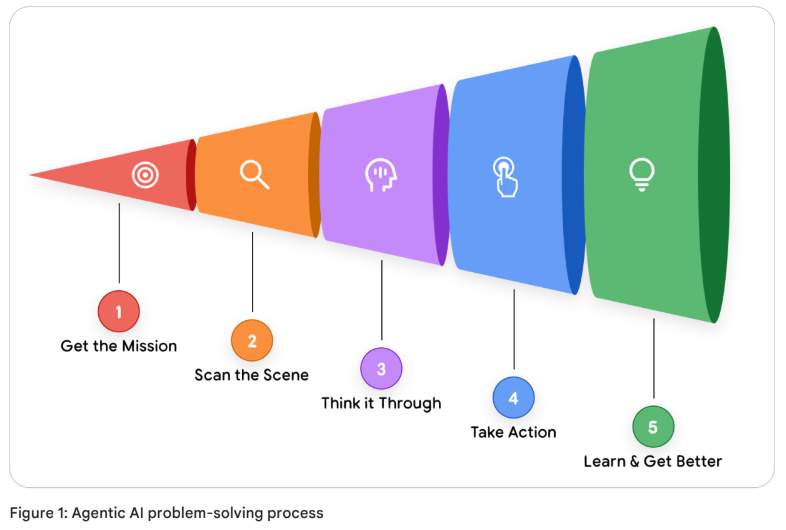
Instead of just answering "How do I book a flight?", an agent takes the task "Book a flight for me," checks your calendar (Scan), realizes it needs flight data (Think), calls a travel API (Act), sees the options (Observe), and then books the best one.
A taxonomy of agent capability (Level 0 to Level 4)
One of the most useful frameworks in the whitepaper is a taxonomy for classifying these systems. A lot of teams get stuck arguing, "Is this an agent?" The paper's taxonomy is a cleaner way to scope what you're building.
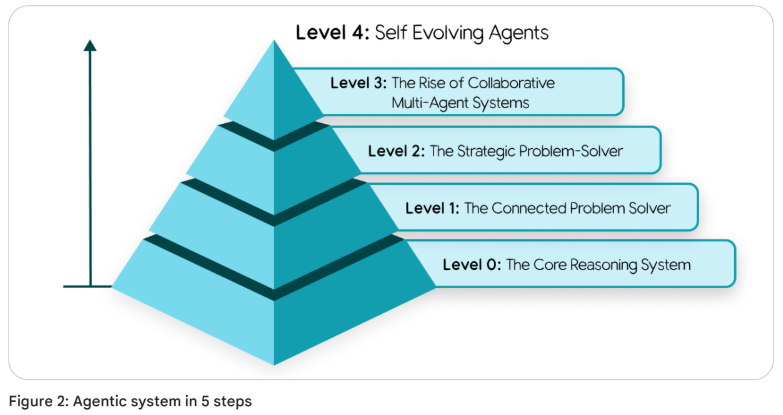
- Level 0 (Core Reasoning): The raw model. Great at explaining and planning, but blind to real-time facts beyond training.
- Level 1 (Connected): The model can use tools to fetch real-time data (like a Google Search, APIs, RAG) to ground its answers in reality.
- Level 2 (Strategic): The agent can plan and actively curate the most relevant information for each step. It breaks a complex goal ("Plan a wedding") into sub-steps and executes them in order.
- Level 3 (Collaborative): This is where it gets interesting. You have a "Manager" agent that delegates tasks to "Specialist" agents (coders, researchers, writers) and, at the end, combines outputs.
- Level 4 (Self-Evolving): The theoretical frontier where agents can write their own tools or create new sub-agents to solve problems they weren't originally programmed for.
If you're building your first production agent, Level 1–2 is where most real business value shows up without complicating your project/system.
MeetGeek: An AI-powered meeting assistant that automatically records, transcribes, summarizes, and analyzes virtual meetings in real time.
Key Features and Architectural Considerations
Building AI agents requires a completely different mindset than traditional software development, where you are curating context for a probabilistic engine. Here are the core components and considerations for building production-grade agents.
Core architecture
1. Model selection
The real-world success depends on agent fundamentals like multi-step reasoning and reliable tool use, then balancing that against cost and latency. A practical pattern is using multiple models:
- A stronger one for planning and hard reasoning, and
- Faster, cheaper ones for routine steps, so you don't waste sledgehammer capacity on small tasks.
2. Tools: Grounding + Action
The whitepaper splits tools into two big buckets:
- Retrieving information (grounding): RAG over vector DBs/knowledge graphs, web search, NL-to-SQL for structured analytics, reducing hallucinations by looking things up before answering.
- Executing actions: Wrapping APIs/functions to send emails, schedule meetings, update records, and, in controlled setups, code execution for dynamic tasks.
It also highlights human-in-the-loop tools (e.g., confirmation, structured user input) for high-stakes steps.
3. Tool wiring needs standards
Agents need structured ways to interact with the world. To make tool use dependable, the paper points to structured contracts like OpenAPI, newer convenience standards like the Model Context Protocol (MCP), allowing the model to speak to software through structured inputs and outputs.
4. Orchestration is the product
The orchestration layer runs the think–act–observe loop and decides what happens next. Done well, it's also where you implement memory, routing, guardrails, and observability.
Agent Ops:
The paper is straightforward that you can't treat agent testing like classic unit tests where the output must exactly equal the expected. Instead, you need an operational discipline, Agent Ops, to measure, debug, and improve behavior over time.
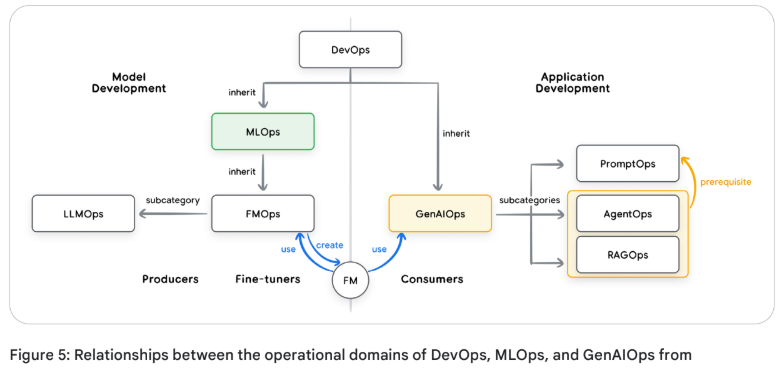
Key practices it recommends:
- Define success like an A/B experiment: Goal completion, satisfaction, latency, and cost tied to business outcomes.
- Evaluate quality, not pass/fail: Use an LM as a judge, meaning using a powerful model to assess the agent's output against a predefined rubric.
- Debug with traces: OpenTelemetry-style traces help you see tool calls, parameters, and what the agent observed.
- Treat human feedback as fuel: Capture human feedback, replicate the issue, and convert that specific scenario into a new, permanent test case in your evaluation dataset.
This is where a lot of agent projects either mature or quietly get turned back into a simple assistant with a few buttons.
Trust, interoperability, and the uncomfortable parts
Once agents can act, your biggest problems stop being prompting and start being permission, identity, and blast radius.
- Agent Sprawl: The paper highlights a very real business risk called Agent Sprawl, where uncontrolled proliferation of AI agents across an organization leads to fragmented systems, duplicated efforts, and increased security/compliance risks.
- Agents should interoperate: The paper describes Agent2Agent (A2A) as a way for agents to advertise capabilities (via "Agent Cards") and collaborate through task-oriented communication.
- Agent Payments Protocol (AP2): If an agent can transact, you need stronger trust primitives for mandates and machine payments. The paper introduces concepts like the Agent Payments Protocol (AP2), which would allow agents to securely transact and pay for services on behalf of a user, necessitating strict financial guardrails.
In Conclusion:
Google's "Introduction to Agents" whitepaper is less about hype and more about turning agent talk into engineering reality. An agent is a looped system with a model, tools, orchestration, and production services. The moment your system can retrieve live facts, take actions, and keep going until a goal is met, you've crossed the line from smart output to software that gets work done.
The practical takeaway also comes with a warning that the hard parts aren't the demo. The hard parts are scoping the right level of autonomy, engineering safe and reliable tools, and building Agent Ops so you can measure and debug behavior over time.
You can check out the entire "Introduction to Agents" guide by Google here.
💡 For Partnership/Promotion on AI Tools Club, please check out our partnership page.
