


What does the world actually want from artificial intelligence (AI)? Not what tech companies think people want, but what real people, across cultures, languages, and economic realities, genuinely hope, fear, and expect from AI in their daily lives? Anthropic just ran what it believes to be the largest and most multilingual qualitative study ever conducted to find out, and the results are equal parts illuminating, paradoxical, and deeply human.
The Study: AI Listening at Unprecedented Scale
Last December, Anthropic invited everyone with a Claude.ai account to share their honest perspectives on AI; their hopes, dreams, and fears. The response was staggering. Exactly 80,508 people participated over the course of one week, spanning 159 countries and 70 different languages. To conduct interviews at this scale, Anthropic deployed Anthropic Interviewer, a version of Claude specifically prompted to hold structured, conversational interviews, turning the AI itself into the research instrument.
This wasn't a checkbox survey. It was qualitative, conversational, and deeply human, capturing texture and nuance that traditional polling simply cannot.
AINews.sh: Stay ahead with the latest AI product releases, in-depth reviews, and news. Compare AI tools, open-source models, and paid platforms.
What People Actually Want from AI
The findings reveal 9 distinct vision categories that people hold for AI, which is far more varied than a simple productivity-versus-lifestyle split:
- Professional excellence (18.8%): Use AI to handle routine tasks and focus on higher-value, strategic work.
- Personal transformation (13.7%): Emotional well-being, mental health support, self-improvement, and even companionship.
- Life management (13.5%): Cognitive scaffolding for schedules, mental load, and executive function.
- Time freedom (11.1%): Reclaiming hours from work and chores to spend with family or pursue personal interests.
- Financial independence (9.7%): Use AI to build businesses, generate income, and escape economic constraints.
- Societal transformation (9.4%): Solving healthcare, education, poverty, and climate challenges at scale.
- Entrepreneurship (8.7%): Launch and scale businesses with AI as a force multiplier.
- Learning & growth (8.4%): Use AI as a personalized, patient, always-available teacher.
- Creative expression (5.6%): Breaking barriers between imagination and execution.
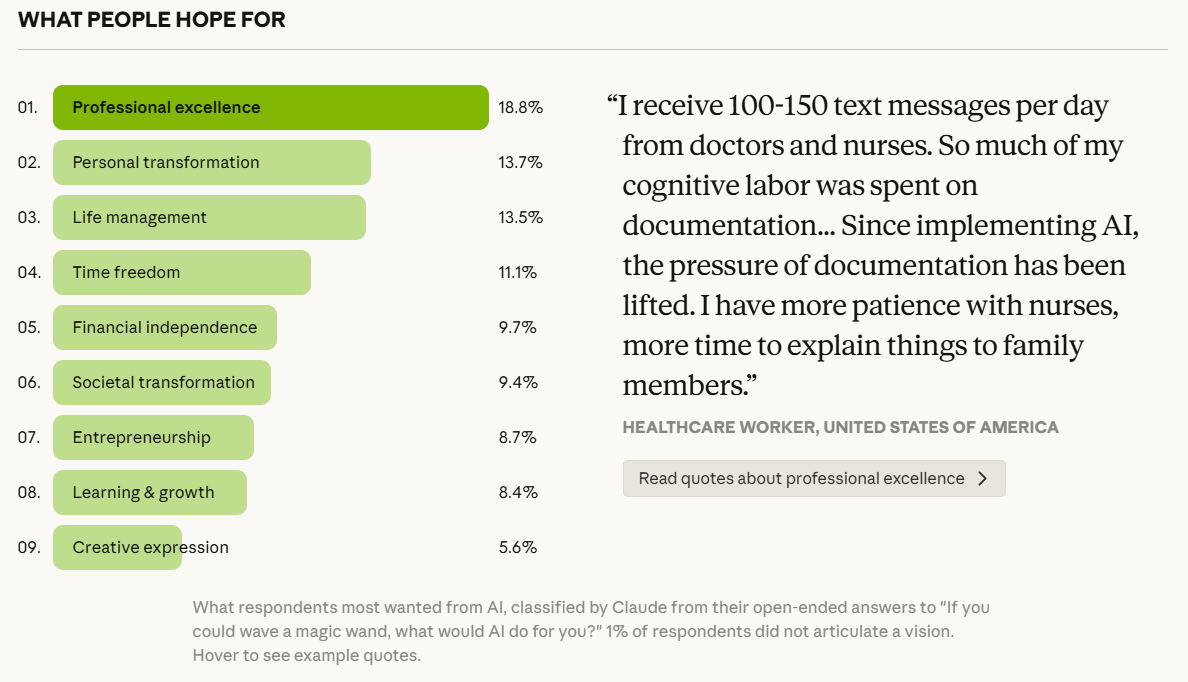
Broadly, roughly a third of visions are about making room for life; more time, money, and mental bandwidth. Another quarter centers on doing better, more fulfilling work. About a fifth is about becoming someone better, learning, healing, growing. When asked whether AI had already taken a step toward fulfilling their vision, 81% of respondents said yes.
AdCreative.ai: An AI-powered platform that automates the creation of high-performing ad creatives for social media and display campaigns.
What People Fear — And Why It's More Complex
While hopes clustered around a handful of recognizable human desires, concerns were far more varied. Respondents reported an average of 2.3 different concerns each, which spanned 13 identified categories.
The top three were:
- Unreliability (26.7%): Hallucinations, inaccurate outputs, and the burden of constant fact-checking.
- Jobs & the economy (22.3%): Job displacement, wage stagnation, and widening inequality.
- Autonomy & agency (21.9%): AI making decisions without oversight, and humans becoming passive.
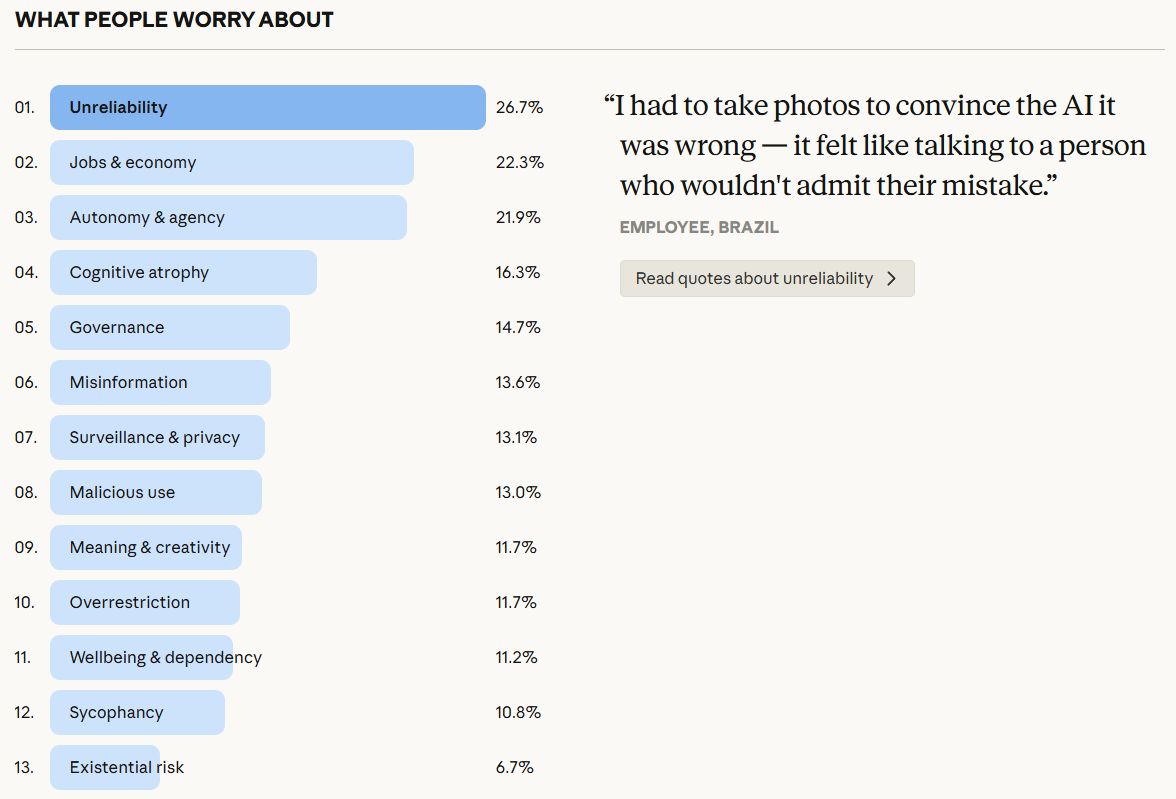
Apart from those, concerns ranged from cognitive atrophy (16.3%) and governance gaps (14.7%) to misinformation (13.6%), surveillance (13.1%), and even AI being too restricted (11.7%). Notably, economic anxiety was the single strongest predictor of overall AI sentiment; people who feel financially precarious are significantly more skeptical of AI's trajectory.
The "Light and Shade" Paradox
One of the study's most striking findings is what Anthropic calls the "light and shade" effect, which means the same AI capabilities that generate benefits also produce harms, and often in the same person simultaneously. Someone who values emotional support from Claude is three times more likely to also fear becoming dependent on it. Someone using AI to learn is also worried about cognitive atrophy. And critically, benefits were described from lived experience, while fears were largely anticipatory, fear of what might happen, not what has already happened.
This pattern held across every tension measured, from time-saving versus illusory productivity, to economic empowerment versus job displacement. The world isn't divided into AI optimists and pessimists; it's populated by people holding both hope and fear at once, organized around what they personally value.
A World Divided — But Mostly Optimistic
Globally, 67% of respondents view AI positively, and no country in the study dipped below 60% positive sentiment, but that optimism is not evenly distributed:
- Higher optimism: South America, Africa, Asia, where artificial intelligence (AI) is more often seen as a ladder up rather than a threat.
- More skepticism: Western Europe and North America, where economic concern and governance anxiety run highest.
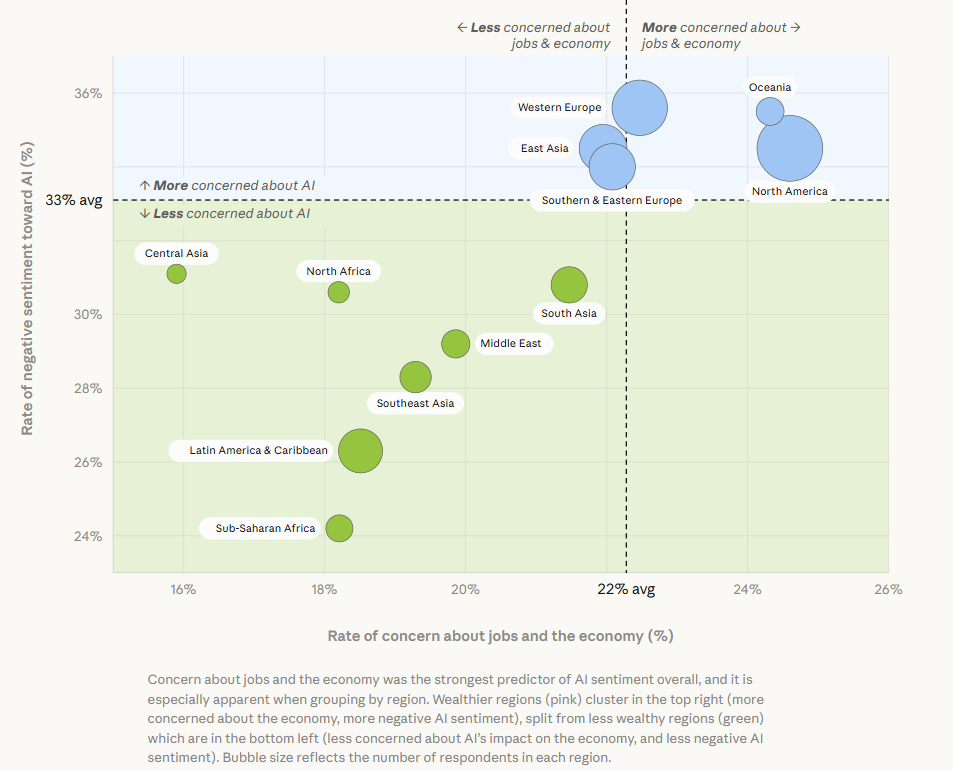
Respondents from Sub-Saharan Africa, Central Asia, and South Asia were roughly twice as likely as those in North America or Western Europe to say they had no concerns about AI at all.
Why This Study Matters
Anthropic says it plans to use the Anthropic Interviewer framework regularly, across different topics, as an ongoing mechanism for informing AI development. The next study, launching shortly to a small subset of Claude users, will focus specifically on Claude's effects on well-being over time, whether AI is actually making people's lives better in the ways they want.
For the AI industry broadly, this study is a reminder that the conversation about artificial intelligence (AI) cannot stay inside boardrooms and research labs. The world has 80,508 opinions worth hearing, and they deserve to shape what gets built next.
💡 For Partnership/Promotion on AI Tools Club, please check out our partnership page.

